
CC.buzz.Score: When customer voices become a driver of innovation
To what extent do companies truly align their processes and services with their customers’ needs? Luc Holzach, co-founder of Customer Metrics AG, is working to make this question measurable. As part of the Innosuisse-supported innovation project CC.buzz.Score, his company developed a tool together with the Lucerne University of Applied Sciences and Arts that converts online customer comments into valuable insights on customer-centricity.

Could you briefly introduce Customer Metrics AG and explain your company’s role in the CC.buzz.Score project?
Luc Holzach, co-founder of Customer Metrics AG: Customer Metrics AG, a spin-off from the Lucerne University of Applied Sciences and Arts (HSLU), helps companies become more customer-centric, meaning that they align their activities more comprehensively with their customers’ needs.
To do this, we assess their level of maturity in this area, identify potential for improvement and support them through the relevant transformation processes. This approach provides a 360-degree perspective. The Customer Centricity Score (CC-Score) measures employees’ perceptions through an internal survey. While customer centricity primarily concerns external customers, employees are often best placed to assess how customer-centric a company’s internal processes are. The Customer Impact Score (CI-Score), in turn, measures customer centricity from the customer’s perspective.
These scores were developed in research projects by Professors Jan-Erik Baars and Dominik Georgi. The marketing agency Partner & Partner is also one of the main founders and owners of Customer Metrics AG. I represent Partner & Partner within the company.
What specific problem did you aim to solve with this project?
We developed, validated and refined CC.buzz.Score iteratively in close cooperation with the Institute of Communication and Marketing (IKM) at HSLU. Since CC.buzz.Score is based on the CI-Score, our knowledge of and experience with this model were essential in defining the tool’s specifications.
The internet contains a vast number of customer opinions and reviews about companies. One of the main challenges is to structure and make use of this information. The project aimed to analyse existing customer reviews, for example on Google Maps, using large language models to assess a company’s customer centricity.
The task was therefore not only to generate scores, but also to assign statements found online to our customer-centricity criteria. The result is CC.buzz.Score, where “CC” stands for customer centricity.
In a nutshell, how does CC.buzz.Score work, and what makes its approach to measuring customer centricity innovative?
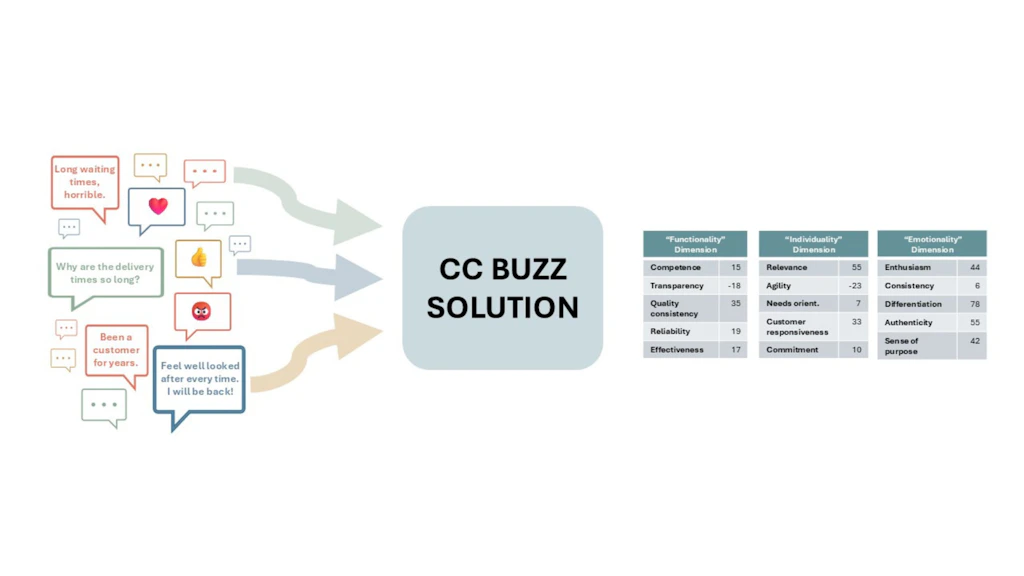
The CC.buzz.Score is generated using a system of prompts based on large language models. Customer comments are assigned to the 15 Customer Impact Score criteria, and score values are then derived from these comments, including through sentiment analysis.
This produces an overall customer centricity score, as well as individual scores for each criterion. Companies can therefore identify the areas in which they have room for improvement.
Firstly, the innovation lies in using existing data, namely customer comments, to generate systematic and quantifiable insights. Secondly, the tool does not focus solely on individual customer experiences. It also captures the underlying factors and a company’s ability to act in a genuinely customer-centric way.



In what ways does CC.buzz.Score differ from other approaches, such as customer satisfaction surveys or manual analysis of customer feedback?
Other indicators, such as customer satisfaction or the Net Promoter Score (NPS), mainly measure the outcome from the customer's perspective. For example, this could be a positive interaction with employees or a product functioning properly.
By contrast, customer centricity looks at the causes behind those outcomes: Does the company understand its customers’ needs? Does it keep its promises? Does it organise its processes consistently around the expectations of its customers?
Measuring customer centricity therefore addresses the root causes, rather than just the symptoms, as other indicators often do. Additionally, the CC.buzz.Score can be automatically generated from existing online signals, without requiring companies to actively survey their customers.
What practical impact can the tool have on companies’ day-to-day operations?
We help companies to strengthen their customer-centricity at a fundamental level. They receive concrete guidance on how to align their culture, organisation and processes more closely with their customers’ needs.
This enables them to develop sustainably, rather than merely addressing individual operational weaknesses, which is often the case with customer satisfaction or customer experience measurements. Customer-centric companies systematically align their activities with customer needs, which supports better outcomes for customers and, indirectly, stronger business performance.
What stage of development or commercialisation has the tool reached today?
An interface for CC.buzz.Score is currently under development. The aim is to enable Customer Metrics employees to use the tool in projects and, in the longer term, to make it directly accessible to clients.
At the same time, we are conducting pilot applications with partner companies and further developing the different elements of the business model, such as pricing and the connection with existing scores. We are also testing the use of data from other sources, including messages sent by customers to customer service teams.
We are also using CC.buzz.Score as part of the Swiss Customer Relations Award organised by CMM360, a news platform focused on customer experience and CRM. Alongside the three existing jury awards, we contribute a public award based on CC.buzz.Score. This gives us an opportunity to position the tool further, both through the award ceremony and its accompanying communication, as well as through our own activities.
How important was Innosuisse support for the development of the project, and what impact did it have?
Support from Innosuisse helped to lay a broader and more robust foundation for the innovation project, particularly through the systematic development of the methodology and the assessment of alternative approaches. It also made it possible to carry out several validation steps and make the necessary adjustments based on the results.
Consequently, the tool is more robust than it would have been without the project. Collaborating with the university team also enabled us to integrate important data science expertise into the development process.
Finally, Innosuisse support enabled us to involve Berner Kantonalbank AG (BEKB) as an important application partner in the project.
Luc Holzach
Luc Holzach is the managing partner and co-founder of Customer Metrics AG. He has also been a senior consultant and partner at Partner & Partner in Winterthur for the past 13 years. The agency is among the main founders and owners of Customer Metrics AG. At Customer Metrics, Luc Holzach shares responsibility for the company’s strategic and operational management.
Support from Innosuisse

Innovation Projects with Implementation Partner
As a private or public company or organisation, apply for financial support to carry out an innovation project with a research partner to develop innovative products, services or processes.